
Intraosseous Access is said to be vascular access obtained from the bone which functions similar to the Intravenous access because the bone marrow of long bone contains veins that ultimately drain into the vena cava and this access is said to be a non-collapsible venous access route and considered as a standard alternative to peripheral intravenous access.
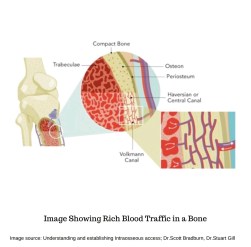 Intraosseous Access is achieved by either drilling or punching through the bone cortex and placing a hollow needle in the bone marrow cavity within which a rich network of marrow vasculature is present which drains into large veins. In Dialysis patients, Intraosseous Access is preferred when it is not possible to get access to central veins or in burn patients where it is very difficult to get central venous access or the patient is critically ill and emergency hemodialysis has to be done immediately. In an emergency, Intraosseous Access is preferred due to its ease and high success rate.
Intraosseous Access is obtained by battery-powered driver needles which are available in three lengths. The length is selected based upon the patient’s size and weight. If the patient is 39 kg or less 15 mm needle is used if the patient is 40 kg and above 25 mm needle is used when the patient is 45 kg with an excess of subcutaneous tissue 45 mm needle to be used.
A local anesthetic is used at the puncture site, the battery-powered driver needle positioned at 90° to the bone surface and inserted through the skin to the bone cortex and into the bone marrow. A decrease in resistance will be felt when the needle enters the marrow cavity. The needle has multiple black lines on its surface. After placing the needle into the bone at least one black line to be visualized above the surface of the skin. If a black line is not seen, the needle selected is too short to reach the medullary space.
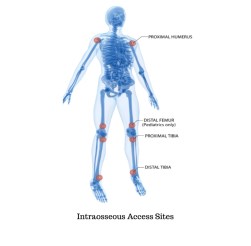 The driver is removed and 2 ml of bone marrow is aspirated with 10cc syringe containing 5cc sterile saline. If the needle flushes easily with no evidence of swelling, the needle is likely to be in the medullary cavity. The central line tube is connected and the needle is secured in its place. The blood flow rate of up to 150 ml/min can be achieved with the Intraosseous route. The rate depends on needle size, access site and dynamics of the marrow space. Proximal tibia, proximal humerus, distal tibia, distal femur, iliac crest, and sternum is said to be an appropriate site to obtain Intraosseous Access.
Intraosseous Access should be limited to emergency circumstances and discontinued as other venous access has been achieved because the Intraosseous Access line should not be left in for more than 24 hours. Complications of Intraosseous Access are rare, common complications seen are osteomyelitis, fracture, extravasation, compartment syndrome and necrosis of the epiphyseal plate. Intraosseous Access should not be used in patients with a history of fracture at or proximal to the insertion site as this can cause extravasation which increases the risk of compartment syndrome, cellulitis or other infection at the insertion site, sites of prior attempts should not be used for a second attempt and patients risk for fracture. 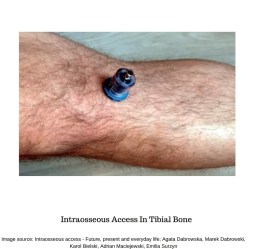
Hemodialysis with Intraosseous Access is very rare may be due to a lack of training and education. A major drawback with Intraosseous Access in hemodialysis is that the access cannot be used for more than 24 hours due to the risk of compartment syndrome and it is said to be painful for the patient so it is preferred only during emergencies and critical conditions.
 LazyKidney
Like!! I blog frequently and I really thank you for your content. The article has truly peaked my interest.
LikeLike