Needle scares us, do they? But getting punctured by a large-bore needle is like an everyday task for kidney failure patients under dialysis, think about that! As a Dialysis Therapist, we are cannulating many patients with these large-bore needles, I would like you to pause for a movement and ask yourself do you know these AVF needles…. I know, let me help you.
The AVF needles are not similar to the normal Intravenous (IV) needles. These AVF needles play a key role in dialysis treatment, they are customized to reach the requirements of the dialysis procedure. For effective dialysis to take place it requires 200 – 400 ml/min of blood flow across the dialyzer (artificial kidney) and this requirement of blood flow can be achieved with the help of AVF needles.
As the prescription of all dialysis patients is individualized, the needle choices should also be individualized to make dialysis treatment more effective. There are different types of AVF needles available with different specifications that play their role to meet the dialysis demands.
- Sharp Fistula Needles
- Blunt/Dull Fistula Needles
- AVF cannula/Fistula Catheter which is also known as Plastic Needle
- Single Needle; used only for Single Needle Dialysis
Anatomy of an AVF Needle:
An ideal AVF needle consists of:
Bevel: An oval slope at the tip of the needle which provides the needle its sharpness and helps to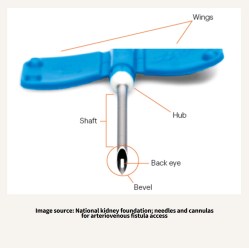 guide the needle easily into the vein through the skin.
Back Eye: Is a tiny hole on the needle wall. Its function is to minimize tissue damage, increase the blood flow and avoid occlusion of the tubing. Back Eye is a must requirement in an arterial needle and of less importance in the venous needle. But it is safe to use a needle with Back Eye for both arterial and venous cannulation.
Shaft: Provides the needle its length. Standard needle length is 1 inch (25mm) (approx.). Needles are also available in the length of 3/4th and 3/5th inch used to cannulate the veins which are <0.4 cm below the skin. 1-inch needles are used to cannulate the veins which are around 0.4 – 1 cm below the skin and 1 ¼ inch needles are used for veins which are > 1 cm from the skin surface.
AVF needles are available in different sizes 18 gauge (which is the smallest) 17 gauge, 16 gauge, 15 gauge and 14 gauge (which is the biggest). Gauge here refers to the needle shaft’s outer diameter.
17 gauge needles are recommended when <300 ml/min of blood flow is sufficient. 17 gauge is more preferred to cannulate new fistulas for 3 weeks.
16 gauge needles are the most common needles used in dialysis patients. About 300 – 350 ml/min of blood flow can be achieved with these needles.
15 gauge needles are usually used in the patient whose fistula is well matured. It can provide blood flow > 350 – 450 ml/min.
14 gauge needles are rarely used and provide blood flow >450 ml/min.
Hub: Hub holds the needle in its place and connects the needle to flexible plastic tubing. Hub presents a black mark and a red mark on either side of it. The black mark denotes the accurate positioning of the bevel and the red mark denotes where the Back Eye is present in the needle.
Wings: Wings provide grip to hold and guide the needle towards the vein. It helps in easy rotation of needle when required and secures the needle by placing a micropore/plaster over it. Needles are available with free wings/ turnable wings and fixed-wing. Tunable wings are said to be more comfortable and safe compared with fixed-wing needles. These wings are color-coded for gauge size identification.
Tubing: Tubing’s of dialysis needle should be flexible, kink-resistant and present with a snap-type clamp with a universal Luer lock that allows smooth connection to the extracorporeal dialysis circuit. The tubing of dialysis needles is available in 15 cm and 30 cm length.
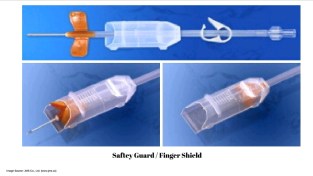 Safety Guard/Finger Shield: Few needles have a safety guard to prevent accidental needle prick to the healthcare provider while disconnecting the needle from the patient’s access.
Needle Cap: Help prevents needle stick injuries. It should be transparent and made of nontoxic Polypropylene (PP) material.
When it comes to Sharp Fistula Needles, these are abundantly used to cannulate AVF/AVG where Rope Ladder Technique and Area Technique are used for cannulation. These needles have ultrathin sharp edges at the tip of their bevel. Whereas Blunt/Dull Fistula Needle is specially used to cannulate an AVF where the Buttonhole technique is utilized. These needles are rounded at the top of the bevel and do not present with sharp edges. Cannulation with these needles causes less pain and decreased infiltration incidents.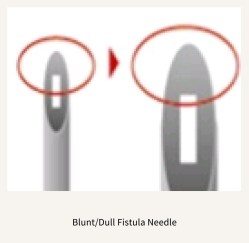
AVF Cannula/ Fistula Catheter also known as Plastic needle is the primary choice of the needle for AVF cannulation in Japan. It is usually recommended for the first few cannulations in a new fistula and fragile AFV’s that have tortuous segments or irregular depths from the skin surface. These needles are made of flexible plastic tube which is less dangerous and can avoid needle infiltration due to its blunt and flexible lumen that lies within the vessel. These Plastic Needles are also used to create buttonhole tracks by leaving the plastic catheter indwelling for extended periods.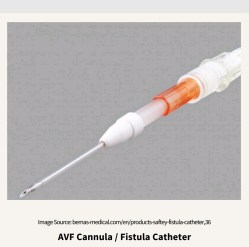
These cannulas are suitable for patients who cannot tolerate immobilization during dialysis and for patients who are undergoing nocturnal dialysis. These Plastic Needles are longer compared with metallic needles and are up to 1 ½ inch. And these are the needle of choice for patients who are allergic to metals. The major drawback of these needles is they cannot withstand required blood flow rates.
Single needle dialysis is preferred in dialysis patients in whom AVF is not matured or fragile and it’s not possible to get two accesses. A Single Needle is used to perform this dialysis procedure and this single needle is similar to the sharp fistula needle but tubing will be divided into two segments. One segment is used to withdraw blood from the needle and the other segment returns the filtered blood to the body through the needle. Specialized dialysis equipment will be used to perform dialysis with a single needle.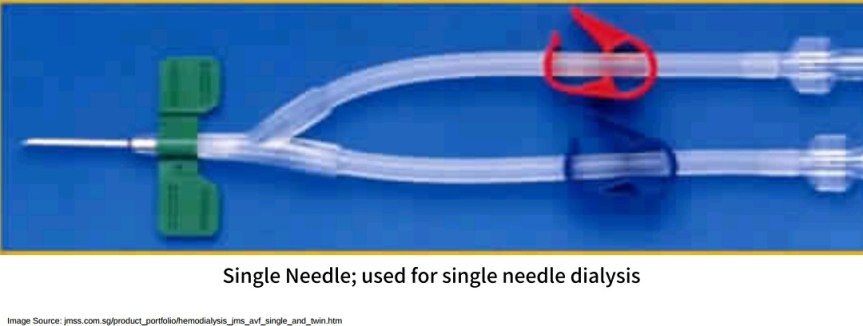
There are different types of fistula needles with different specifications and materials available to cannulate AVF/AVG. Before cannulating a dialysis patient it should be checked whether the needle is biocompatible with the patient.
The majority of the fistula needles are made of metals. These metal needles are siliconized to minimize pain during insertion, provide smoother and more comfortable penetration with less flow resistance. Siliconizing the needle also avoids blood coagulation and hemolysis inside the needle. Plastic Needles are used in patients who are allergic to metals and silicone.
Tubing should be made of nontoxic non-pyrogenic medical graded elastic PVC materials which offer suitable flexibility to meet its function. All these needles used to cannulate AVF/AVG should be designed to meet all OSHA (Occupational Safety and Health Administration) safety requirements.
Sterilization methods of needles should be checked before using the needle to a dialysis patient as few patients can be allergic to certain sterilizing agents. AVF needles are sterilized either by gamma irradiation or ethylene oxide gas (ETO).
There are many AVF/AVG needles available and the choice should be made based on the characteristics of individuals AVF/AVG, desired blood flow rate for effective dialysis and the access complication present at the time of treatment.


Like!! I blog frequently and I really thank you for your content. The article has truly peaked my interest.
LikeLike