Acute blood loss through vascular access can be a life-threatening problem, blood loss through Arteriovenous Fistula (AVF) & Graft can be from aneurysms, stenosis and subsequent rupture, infection, trauma, suicide and use of anticoagulants and antiplatelet drugs.
AVF site bleeding or dialysis site bleeding is known as Post-hemodialysis site hemorrhage (PHSH). PHSH can be a nightmare for dialysis patient as well as the dialysis nurse and therapists and such patients should be rushed to the Emergency Room (ER) immediately.
PHSH sometimes can be simple as that can be treated by dialysis therapists and sometimes it may lead to life-threatening bleeding complications that require surgical repair.
Majority of dialysis patients presents with persistent bleeding from the access site on the AVF after dialysis despite direct pressure given by dialysis therapists. Patients with AVF or AVG are accessed with 17 – 15 gauge needles resulting in relatively large puncture site and heparin, an anticoagulant a blood thinner is used to prevent clotting of blood in the dialysis circuit. Along with this, dialysis patient’s blood will be rich with uremia and platelet dysfunction that makes bleeding management difficult.
Here are some techniques that are proven successful to stop bleeding from AVF access site.
DIRECT PRESSURE:
Direct Pressure over the bleeding site is simple important and most successful intervention to stop dialysis site bleeding. After withdrawing the needle from the dialysis site direct pressure of at least 10-15 min is recommended before placing a band-aid or rolling it tightly with a tourniquet (which is not recommended).
When increased PHSH occurs direct pressure needs to be applied with gloved hands for at least 15-30 min using two hand technique while the nondominant hand putting pressure proximal to the bleeding site and the dominant hand putting pressure on the bleeding site.
Most of the theories say excessive pressure leads to iatrogenic fistula thrombosis. But we are not clear that how much pressure is too much pressure?
PROTAMINE SULFATE:
Protamine sulfate is used when it is unable to stop bleeding immediately after withdrawing needles from dialysis site even after 10-15 min of direct pressure should prompt consideration of excessive heparin anticoagulation.
Under these circumstances, the effects of heparin can be reversed with intravenous administration of protamine sulfate over 10-15 min. The recommended dose is 1 mg of protamine sulfate for 100 IU of heparin. If Heparin dose is unknown 10-20 mg of protamine should be sufficient.
TISSUE GLUE: 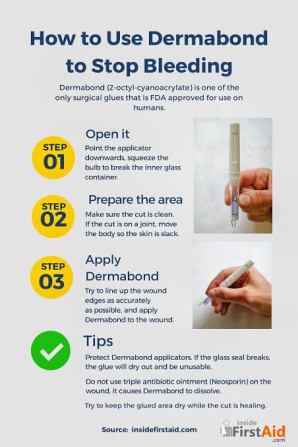
This technique Includes use of Dermabond (2 octyl- cyanoacrylate), tissue glue used in wound closure and also can be used in the management of PHSH.
To apply tissue glue pressure should be applied above & beyond the bleeding site. A small amount of Lidocaine with epinephrine is injected to provide analgesia and partial hemostatic control. After a few seconds, tissue glue is applied generously over the bleeding site. This technique is best suited for minor bleeding like oozing.
GALLIPOTS:
A simple and temporary technique to stop the bleeding when PHSH occurs at home, It is a simple procedure where a gallipot (basin) is placed upright on the bleeding site over folded sterile gauze and then strapped down using adhesive tape.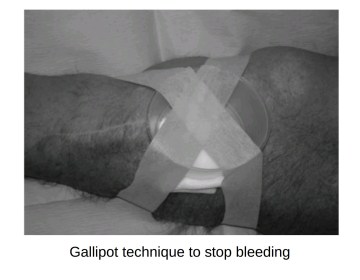
This provides adequate pressure to control bleeding and prevent the fistula from clotting thereby managing bleeding from dialysis site until the patient reaches the ER.
GELATINS:
Gelatin sponges will be available in the ER and in dialysis unit as Gelfoam. Gelfoam is hemostatic gelatin that can provide homeostasis providing a matrix to facilitate platelet aggregation and coagulation. This mechanism does not rely on coagulation cascade. 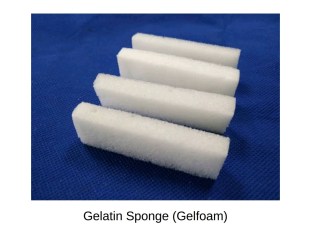
Gelfoam sponges before use should be cut into appropriate sizes and can be applied dry or saturated with sterile, isotonic normal saline. The sponge should be applied in tandem with direct pressure over the bleeding site.
If the appropriate size of gelfoam is utilized, the product should be absorbed completely with little tissue reaction. Once bleeding stops, compressive bandages should be applied.
TOPICAL THROMBIN:
Thrombin is commonly used in surgical homeostasis. Use of human thrombin is limited by the possibility of transmitting blood-borne pathogens. Therefore, FDA-approved recombinant thrombin has been developed in 2008, with the specific advantages of being minimally antigenic and having less risk of viral disease transmission. 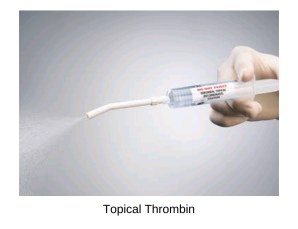
This thrombin can be used alone or in combination with gelfoam. The use of thrombin along with gelfoam is well established in surgical settings. However, the expense of these agents may prohibit their routine use in minor bleeding.
A vascular surgeon should be immediately consulted if hemorrhage cannot be controlled leading to life-threatening bleeding. An adjunctive suture may be placed if there appears to be a small laceration rather than a puncture wound. This suture should only be used after other measures to control bleeding described above have failed.
Worst-case scenario, a tourniquet or strong manual pressure can be applied proximal to the puncture site. This will invariably result in thrombosis formation within the fistula or graft, making it nonfunctional. Such extreme measures are rarely necessary but may be life-saving in specific circumstances.
 LazyKidney
Like!! Thank you for publishing this awesome article.
LikeLike