
The complication rate of Arteriovenous fistula (AVF) is low compared with Arteriovenous graft and Central venous catheters. Still, the most common complications associated with a mature hemodialysis arteriovenous fistula are an aneurysm, fistula thrombosis, infection, stenotic vascular lesions, access recirculation, and extremity ischemia.
Most of these common complications can be avoided by regular physical examination of AVF to check the access patency and maintaining the access area clean.
Aneurysms 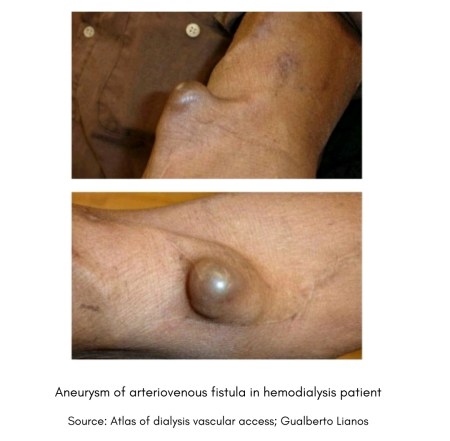
An aneurysm is a focal dilation of vessels with true aneurysms involving all the layers of the vessel. Pseudoaneurysm represents a collection of blood and connective tissue outside the vessel wall.
Aneurysm form in areas of repeated needle puncture sites. There is an increased risk of bleeding each time after insertion and removal of dialysis needle. Pseudoaneurysms are often due to iatrogenic trauma, primarily repeated needle punctures.
If the aneurysm is suspected or detected, the size of bulging should be documented at each dialysis session. Change in size should be carefully noted and patients who have a rapidly enlarging bulge should be referred for surgical evaluation. 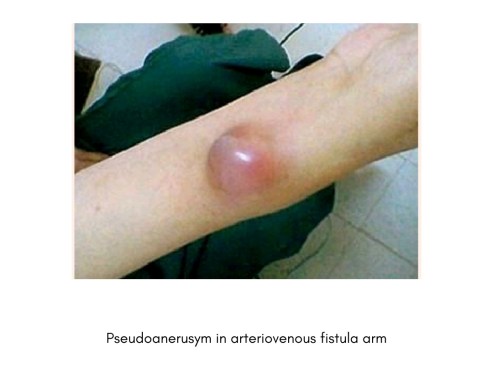
Overlying skin should be examined for marked thinning, ulceration or spontaneous bleeding. Depigmentation and tightening of the overlying skin may also be observed. Overlying skin that is tissue paper thin should prompt surgical evaluation. Ulceration or spontaneous bleeding of an aneurysm should be considered as an indication for emergent surgical evaluation. Cannulation should not be continued along any type of aneurysm.
Aneurysms are fusiform, develop slowly over several years and lie beneath intact, nonulcerated skin making it less prone to infection and rupture. Surgical options to repair large aneurysms are limited and often involve loss of the AVF.
Thrombosed Fistula
If AVF no longer has any detectable flow i.e. pulse, thrill and bruit is considered as a thrombosed AVF.
Collateral flow can be developed even after fistula has become completely obstructed by thrombus. In some AVF flow can be diminished that it can no longer detectable or all the flow is going through collaterals.
Infected Fistula 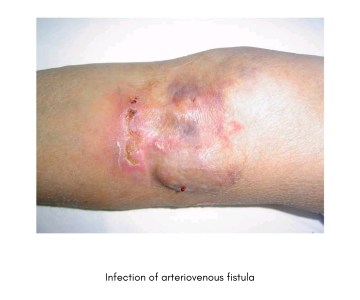
Superficial Infection: Generally related to the cannulation site and do not involve fistula. Seen as small pustular lesions with minimal or no inflammation along with swelling and pain.
Deep Infection: Physical findings include localized erythema, swelling, tenderness, purulence and fistula site will be warmer than normal. Deep infections are frequently associated with purulent drainage and maybe sometime fluctuant to palpation.
Stenotic vascular lesions
Stenotic vascular lesions can occur anywhere along the vascular access circuit and considered as one of the most common complications associated with mature AVF.
Regular physical examination of AVF and its extremities is the best way to detect stenotic vascular lesions. Three types of Stenotic vascular lesions are seen with AVF;
- Venous Stenosis
- Arterial Stenosis
- Central Venous Stenosis
Venous Stenosis:
Physical Findings: Persistent arm swelling, prolonged bleeding after needle withdrawal, and the presence of collateral veins. Negative arm elevation test, i.e. when the fistula arm is elevated to a level above the heart and the fistula does not collapse as it normally should.
Venous stenosis often results in alteration of the pulse, thrill, and bruit. Strong pulse should be considered as an adverse finding in a fistula as it suggests an increase in venous resistance. Thrill associated with stenotic fistula may not have its diastolic component when compared with normal fistula. Bruit in severe stenosis may become high pitched causing whistling sound during systole. High pitch bruit is common due to increasing resistance from the stenotic lesions.
Arterial Stenosis:
Arterial stenosis presents with hyper pulsatile fistula with reduced pulse augmentation. If hyper pulsatile does not augment with occlusion, it suggests that the inflow stenosis is essentially a complete obstruction.
Central Venous Stenosis:
Physical findings may differ from the venous stenosis. Central venous stenosis consists of massive ipsilateral arm edema. Subcutaneous collateral veins are frequently evident over the arm and chest. Swelling and collateral veins are caused by generalized venous hypertension of the arm, which occurs in central but not peripheral stenosis.
Not all central venous lesions are hemodynamically significant. In some, swelling of hand or arm will be minimal or the development of chest wall collaterals suggests clinically significant central venous lesions. Pulse over the fistula will not be strong as in venous stenosis, because of the elasticity of the veins between fistula and area of stenosis.
Testing for Recirculation
The most common cause of recirculation is the presence of high-grade venous stenosis leading to backflow into the arterial needle.
To detect access recirculation, occlude the fistula between the two needles during dialysis and observe the venous and arterial pressure gauges. In normal fistula very little or no change is observed in either the venous or arterial pressure readings.
If recirculation is due to venous stenosis the pressure will increase in venous return. As pressure limits are exceeded the alarm will sound and blood pump will stop.
If recirculation is due to arterial stenosis, the occlusion will lead to decrease in pressure since the blood pump will demand more blood than is available. In this instance, jerk can be noticed in the arterial side of tubing and blood pump goes off.
If needles are placed very closely together, this examination will not be possible.
Ischemia
Dialysis Ischemic Steal Syndrome: 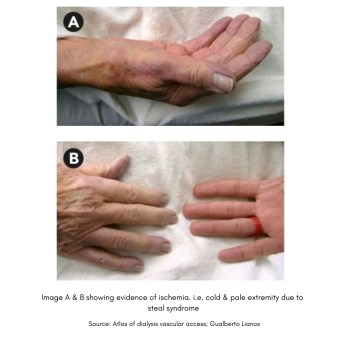
Also called as Dialysis Access Steal Syndrome, it can occur any time after access placement.
Physical findings include comparing the affected hand with the contralateral one. Often find with pain and cold extremity which appears pale or cyanotic. Radial pulse is generally diminished or absent in many individuals with steal syndrome.
Chronic ischemia presents with ulceration and gangrene at fingertips. Compression of access relives painful symptoms.
Ischemic Monomelic Neuropathy:
Are seen immediately following access surgeries and are characterized by ischemic changes that are confined to the nerves of the hand.
Pathognomic features include the presence of diffuse, neurologic dysfunction along with severe pain, peristalsis, and numbness of hand with diffuse motor weakness or paralysis. Typically hand will be warm often with palpable radial pulses and audible Doppler signal is present.
Arteriovenous Fistula (AVF) surveillance does not prolong fistula life, but it may help to avoid and reduce fistula complications.
 LazyKidney
Thanks dear.
LikeLike
Anytime Viviene
LikeLike