Arteriovenous Fistula (AVF) is the most preferred vascular access in dialysis patients. It is a connection between an artery and a vein in the arm or leg of the patient. After creating the anastomosis between an artery and a vein it is left undisturbed for 3 – 6 weeks for AVF to mature. During the maturation period, the vein continues to grow larger and wider. The blood flow rate and vein diameter increase to accommodate the high-pressure arterial blood entering the vein.
An AVF to be called matured and fit for dialysis use has to pass the “Rule of 6s” i.e. At 6 weeks post-creation, the diameter of the vein should be at least 6 mm, the depth of vein should not be more than 0.6 cm, the blood flow rate should be 600 ml/min, and the length of fistula should be 6 cm to allow successful two-needle dialysis.
The majority of AVF created does not meet all the above criteria which makes it difficult to cannulate. And many AVF have prominent bruit and thrill but veins are present deep which makes it difficult to find the vein and cannulate which if not done properly might lead to access-related complications. Because of these reasons the patient has to go back for Central Venous Catheter (CVC) or Arteriovenous Graft (AVG) as their vascular access which is higher in cost and less preferred for maintenance hemodialysis due to its high complication rate compared with AVF. To avoid patients settling with CVC/AVG there are many techniques and procedure which helps make difficult cannulation easy.
Transposition of Vein 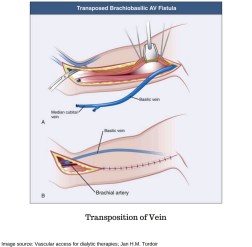
Elevated transposition and Tunneled transposition are the two techniques that are used to superficialize the vein which lies under the skin to make cannulation easy. Transposition of the vein has its risk of immediate and delayed complication which includes damage to the vein wall leading to progressive aneurysmal degeneration and also twists and kinks creating stenosis near the elbow region.
AVF should be cannulated 4 – 6 weeks after transposition for a better outcome and enough time for the wound to heal.
The Sine-wave technique to superficialize the deep vein 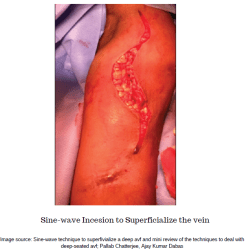
The Sine-wave technique is a superficialization technique used when a deep AVF cannot be cannulated. This technique involves a Sine-wave incision done over the AVF and the skin flaps around the vein are raised. The vein will be mobilized completely off its bed then the flaps around the vein are thinned out by removing unwanted fats.
The Sine-wave technique aims to obtain skin flaps with just enough layer of fat overlying the fistula which makes cannulation easy due to improved palpability. The vein can be cannulated for dialysis anytime after 2 weeks.
Lipectomy
Lipectomy is the treatment of choice in obese dialysis patients where a mature outflow vein is located deeper than 6 mm and is difficult to cannulate.
Lipectomy is a minimally invasive surgical procedure carried out through a small incision where the adipose tissue present on and sides of the vein are removed to superficialize the outflow vein. Lipectomy avoids mobilization of the vein preventing damage and preserves the primary course of the vein. It is done at the time of fistula creation and /or after the creation and maturation of AVF.
Cannulation after lipectomy should be done after 1 month with clinical evaluation and color doppler ultrasound imaging evaluation. Early cannulation before 1 month should not be performed because of the risk of subcutaneous hematoma due to insufficient integration of the vein in the surrounding tissues.
Polycarbonate Pegs 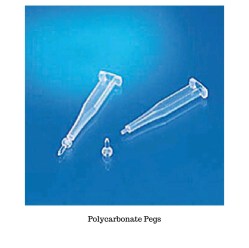
Polycarbonate Pegs are used for a short period to form a track for the Buttonhole technique cannulation. Buttonhole technique is vastly used in dialysis patients due to its easy puncture, less pain and require less time for hemostasis. But it requires skilled staff and a long time to form the tract. Buttonhole technique using Polycarbonate Pegs will shorten the time needed for tract formation.
Polycarbonate Pegs are used to form a fixed puncture tract to be created quickly in 1 – 2 weeks. The peg is placed at the site where the dialysis needle has just been removed. The peg remains in place until the next dialysis session when it is removed. The dialysis treatment is completed as usual and a new peg is inserted after homeostasis has been achieved. This is repeatedly done for 1 – 2 weeks until the tunnel is formed. Once the tunnel tract is formed use of peg is stopped and a dull/blunt needle is inserted along the track each time.
Using Polycarbonate Pegs reduces the risk of needling complications, risk of AVF failure, fast transition to blunt/dull needles helpful to cannulate difficult access and also the same Polycarbonate Pegs reported to be discomfort, have high bleeding episodes, high cost and increased risk of infection.
Polycarbonate Pegs reduce the creation of multiple tracks of Buttonhole thus lowering cannulation difficulty and prolong AVF survival.
VWING device 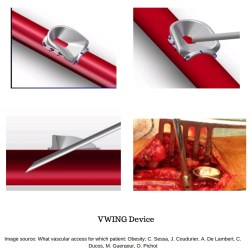
Venous Window Needle Guide (VWING) is a surgically implanted subcutaneous device that guides the needle into the vein. It is a cannulation device designed to cannulate AFV’s which are normally dilated but too deeply situated.
VWING is a titanium device helpful for cannulation with the Buttonhole technique. It incorporates a broad funnel configuration that provides a target that directs the needle to a cannulation window and the vessel wall. It is palpable and facilitates reliable localization of the device. The device is sutured to the anterior AVF wall and coated with titanium beads to promote the ingrowth of vessel wall tissue.
The VWING device is of 17.7 mm in length and available in 7 and 9 mm widths and 4,6,8 and 10 mm heights to accommodate varying AVF depths and diameter. VWING is considered in patients in whom the fistula cannot be palpitated to locate and define its margins, fistula is too torturous to be cannulated, fistula segment cannot accommodate two needles and AVF with a range of 6 mm to 15 mm in depth.
Liposuction
Liposuction is performed around AVF to facilitate the usage of deeply seated veins as hemodialysis access. It is done through a small skin incision with potentially fewer complications.
Liposuction is preferred in AVF with a minimum of 6 weeks after its creation and found difficult to cannulate. The fistula should not be cannulated for 6 weeks after liposuction and before its use for hemodialysis.
Ultrasound-guided AVF cannulation
Portable and high-resolution ultrasound scanners have accelerated the interest in the use of ultrasound guidance for interventional procedures.
Ultrasound used for cannulating AVF results in a greater likely hood of successful cannulation with less complication and less time spent on the procedure. By using ultrasound in dialysis treatments we can avoid multiple access attempts which result in damage to the fistula, poor patient satisfaction, and unnecessary expenses.
AVF needle with different length
AVF needle is available in the length of 3/4th and 3/5th inch used to cannulate the veins which are <0.4 cm below the skin. 1-inch needles are used to cannulate the veins which are around 0.4 – 1 cm below the skin and 1 ¼ inch needles are used for veins which are > 1 cm from the skin surface.
Plastic flexible needles are also available with a needle length of 1 ½ inch which allows easy cannulation of deep veins.
Click Here to know more about dialysis needles.
AVF is said to be the lifeline of dialysis patients and all these techniques are utilized to improve the patency of AVF and easy cannulation which provides efficient dialysis and improves the quality of life on dialysis.
 LazyKidney
Useful information
LikeLiked by 1 person