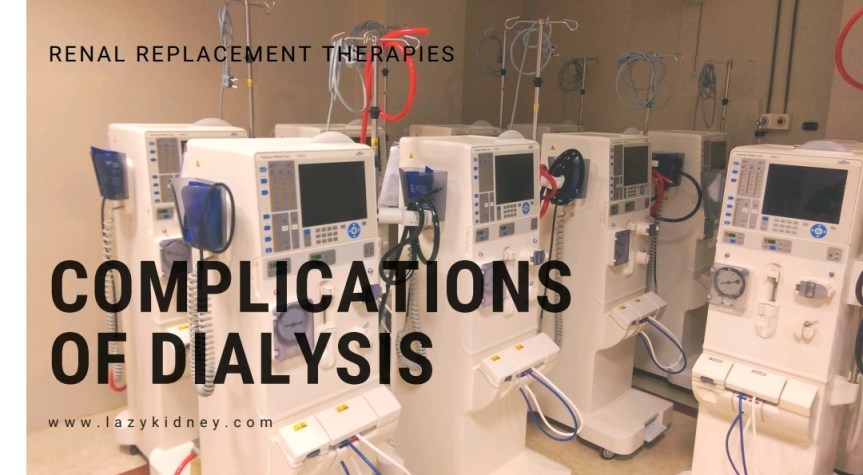
We know that dialysis is a life-saving treatment for people with kidney failure. But, what if; that life-saving treatment has its own set of complications. We know that for every action there is an equal and opposite reaction, for every advantage, there is a disadvantage, if we gain something we sacrifice something. The same way, dialysis is a life-saving treatment but if not done properly results in serious complications.
From 7 decades we are treating renal failure patients with dialysis and we came across many complications of this procedure. In this post, we go through a few of the common complications of dialysis, how to avoid and treat these complications and improve the quality of life on dialysis.
Complications of Vascular Access in dialysis patients
Vascular access is something which allows us to remove blood so that it can be filtered through the dialyzer and return the blood back to the body. Vascular access is an anastomosis of a major vein with a major artery usually in the forearm, upper arm or thigh.
Three different types of vascular access are used in dialysis patients;
Arteriovenous Fistula (AVF) 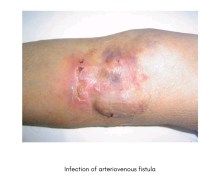
AVF is a surgical creation of an anastomosis between major artery and major vein either in the forearm, upper arm or thigh. After the surgical creation of AVF, the patient has to wait for 3 – 4 weeks for the veins to develop to grant access for blood during dialysis treatment.
Some AVF fails to develop due to thrombosis, infection, surgical and endovascular ligation of tributary veins. All the complications of AVF are discussed separately in Simple Tests To Detect Serious AVF Complications In Hemodialysis Patients.
Arteriovenous Graft (AVG)
A Polytetrafluoroethylene (PTFE) tube placed as a connection between a major artery and a major vein in the forearm or upper arm. AVG can be used within 2 weeks after its placement and if not handled properly results in early thrombosis. AVG also has a long term risk of infection and venous stenosis.
Central Venous Catheters (CVC)
CVC is a silicone tube placed inside one of the major central veins of the body to access blood for dialysis treatment. CVC can be used immediately and has a higher rate of infection and thrombosis compared with other types of vascular access. CVC infection if not treated leads to major complications. Treatment includes antibiotics, in severe cases removal of CVC will be the only choice.
Click here to know how to care for dialysis catheters at home.
Vascular access complication can be avoided by regular physical examination, monitoring of static and dynamic venous pressure, blood flow in the vascular access, measuring access recirculation and correction of stenotic lesions.
Anemia in dialysis patients
Anemia in dialysis patients is common and is mainly due to erythropoietin deficiency and shortened Red Blood Cell (RBC) survival.
Complications of anemia include Left Ventricular Hypertrophy, decreased exercise capability, increased hypotensive episodes during dialysis, decreased the quality of life, increased sexual dysfunction and decreased cognitive capability.
Anemia in dialysis patients is treated with recombinant erythropoietin administration, correction of iron deficiency and in severe cases blood transfusion helps bring back the hemoglobin level to normal.
Click here to know why anemia is more common in dialysis patients.
Cardiovascular diseases in dialysis patients
Cardiovascular disease in dialysis patients is multifactorial. Majority of dialysis patients are hypertensive and on antihypertensive medications, which in long term results in arrhythmia, left ventricular hypertrophy, cardiomyopathy, ischemic heart disease, etc.
Somehow, Dialysis therapy itself is a risk factor for cardiovascular disease due to the creation of AVF, AVG, and placing a CVC which on long term might result in stenosis, atherosclerosis, peripheral vascular disease, and vascular calcification.
Treatments include antihypertensive medications and regular cardiac screening. Cardiovascular diseases in dialysis is discussed separately.
Malnutrition in dialysis patients
Malnutrition is very common in dialysis patients due to huge diet restriction, decreases apatite, removal of protein across dialyser, and inflammatory mediators from the dialysate.
In dialysis patients recommended daily dietary protein is ≥ 1.2 g/kg of body weight and, recommended daily energy intake of 35 kcal/kg of body weight for people ≤ 60 years and 30-35 kcal/kg body weight of people > 60years of age
Regular patient education on diet management, the nutritional assessment that includes maintaining normal serum albumin, oral nutritional supplementation, intradialytic parenteral nutritional, vitamin, trace element supplementation, and adequate dialysis will keep the dialysis patients away from malnutrition.
Infection in dialysis patients
Infection is the second leading cause of death in dialysis patients due to the risk factors such as diabetes mellitus, older age, hypoalbuminemia, catheters for vascular access, reprocessing of dialysers, malnutrition and decreased immunity.
Higher chance of hepatitis and HIV transmission due to cross-contamination and requirement of blood and blood product transfusion secondary to erythropoietic agents during dialysis treatment. To keep the dialysis patients away from infections every unit has its own protocol for administration and management of hepatitis, pneumococcal and influenza vaccines.
Renal Osteodystrophy in dialysis patients
Renal osteodystrophy is bone disorder seen in dialysis patients due to secondary hyperparathyroidism because of renal retention of phosphorus leading to hyperphosphatemia, hypocalcemia, low calcitriol levels and skeletal resistance to PTH.
Common signs of secondary hyperparathyroidism include bone pain, muscle weakness, tendon rupture, pruritus, metastatic and extraskeletal calcification in dialysis patients.
Treatment includes the reduction in the phosphorus intake by phosphorus restricted diet, use of phosphorus binders, vitamin D administration and in severe cases parathyroidectomy.
Skin disorders in dialysis patients 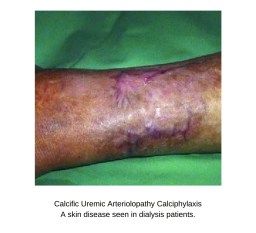
A skin disorder seen in dialysis patient is usually Calcific uremic arteriolopathy calciphylaxis.
Calcific uremic arteriolopathy calciphylaxis is a skin disorder characterized by arteriolar calcification in dermis presents as painful red nodules or plaques which progress to form ulcerative lesions with necrotic centers and violet borders.
Treatment includes control of calcium and phosphorus products, discontinuation of vitamin D analogs, parathyroidectomy if PTH > 500 pg/ml and consider daily dialysis.
Intradialytic Complications of dialysis
Hypotension
Hypotension is the most common complication during dialysis and more common in older patients and women. Hypotension during dialysis is due to the reduction in the blood volume, autonomic dysfunction, dialysis membrane biocompatibility, and antihypertensive medications.
Treatment includes decreased ultrafiltration rate, increased dialysate sodium concentration, increased dialysate calcium concentration, use of variable sodium and ultrafiltration modeling, decreased dialysate temperature, use of biocompatible membrane and minimize short-acting antihypertensives within 4 hours of dialysis.
Muscle Cramps
Muscle cramps are also seen commonly during dialysis and are usually seen associated with hypotensive episodes. Muscle cramps in dialysis patients are mainly due to acute extracellular volume contraction.
Treatment includes decreased ultrafiltration rate, administration of normal or hypertonic saline, pharmacologic agents such as carnitine, vitamin E or quinine sulfate and increase in estimated dry weight.
Dialysis Disequilibrium Syndrome
Dialysis Disequilibrium Syndrome is usually left undiagnosed and occurs due to the rapid rates of change in solute concentration and pH in the central nervous system and most commonly occurs with high initial solute clearance.
Treatment to avoid and reduce disequilibrium include the use of small surface are dialysers, less blood flow rate, and dialysate flow rate, concurrent dialysate flow and high dialysate sodium.
These are the few common complications of dialysis treatments. It is not meant that all the patients who are on dialysis will go through all these complications if dialysis treatment is done with proper care and a patient receives adequate dialysis with proprer diet management he/she can live on dialysis without any complications.
 LazyKidney