
Physical examination is the best method to inspect and detect common problems associated with an arteriovenous fistula (AVF).
Because
- It is easy and inexpensive
- High degree of accuracy for detecting a dysfunctional AVF
- If performed at regular intervals helps in early detection of problems that are commonly associated with AVF, thus avoiding missed dialysis treatments and emergency situations.
Physical examination can be used as a monitoring tool to avoid complications associated with following vascular access failures. Three main components of physical examinations are;
- Inspection (look)
- Palpation (touch)
- Auscultation (listen)
Physical examinations of AVF should be done on every Hemodialysis treatment, if not at least once a week. Inspection of the access arm should not be neglected.
1. Inspection of Fistula: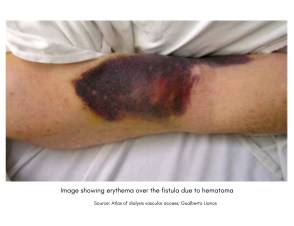
- The skin overlying the fistula should be normal without erythema (reddish discoloration of the skin), focal masses or focal swelling.
- Cannulation sites should be healed well with minimal or no scabbing and no evidence of inflammation.
- Aneurysm should not be present. If present the skin overlying the bulging area should be examined for evidence of depigmentation, thinning, ulceration or spontaneous bleeding.
- Normal AVF should collapse if the fistula arm is elevated above that of the heart, large mega-fistulas will at least become flaccid. If fistula collapses when fistula arm is extended, it is a good sign that outflow of the fistula is normal.
2. Thrill: 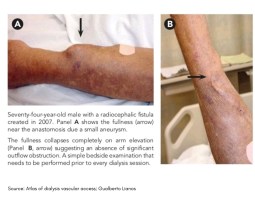
- The normal AVF is characterized by a soft, continuous, diffuse thrill that is palpable over the course of the fistula and most prominent over the arteriovenous anastomosis.
- A thrill is a palpable vibration over AVF that is related to flow.
- A thrill is evaluated using the palm of the hand.
- The thrill has both systolic and diastolic component.
3. Bruit:
- Bruit is the auditory manifestation of a thrill, often referred to as a buzz usually heard by a stethoscope.
- Bruit is characterized by both the auditory frequency and the duration of flow.
- A well functioning AVF has a low-pitched, soft, machinery-like rubbing sound.
4. Auscultation:
Auscultation of an AVF can be performed using a stethoscope or with the help of a hand-held continuous wave Doppler.
5. Palpation:
- Palpation should not elect any pain over the AVF or its extremity.
- Normal AVF should be soft and compressible.
- The skin overlying an AVF may be warm to touch.
6. Pulse:
- Pulse of AVF should be checked with fingers, not with palm or thumb.
- Pulse of an AVF will be elevated along the length of fistula from the arteriovenous anastomosis through the venous outflow.
- When the normal fistula is occluded a short distance from the arteriovenous anastomosis, the arterial pulse at the wrist should be increased. This increase in the arterial pulse is directly proportional to the quality of the arterial inflow.
7. Inspection of Extremity: 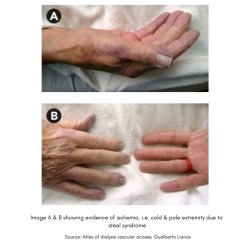
- AVF hand should be normal without evidence for ischemia. Fistula arm, if found cold or pale, should be diagnosed for steal syndrome.
- There should be no edema of the extremity. If edema is found should be diagnosed for stenosis.
8. Direction of Flow:
- Some fistulas have a bidirectional flow; blood flows from both directions.
- The direction of flow can be easily determined by occluding the fistula with the tip of the finger and palpating on each side of the occlusion and point for a pulse.
- The side without a pulse is considered as venous side or downstream.
- The pulse which is an increase in intensity during the occlusion is considered as the arterial side of the anastomosis.
- This should be done usually when patients are not on dialysis.
- When AVF is occluded between the two needles during dialysis, very little or no change is observed in either the venous or arterial pressure readings. Any difference in pressure indicates the presence of fistula recirculation.
These are some of the physical manifestation or physical examination of a normal functioning mature arteriovenous fistula. The patient should be referred for diagnostic testing as soon as any abnormality is detected by physical examination. The principal options for diagnostic testing are ultrasound imaging and angiography.
GOOD LUCK SAVING LIVES.
 LazyKidney