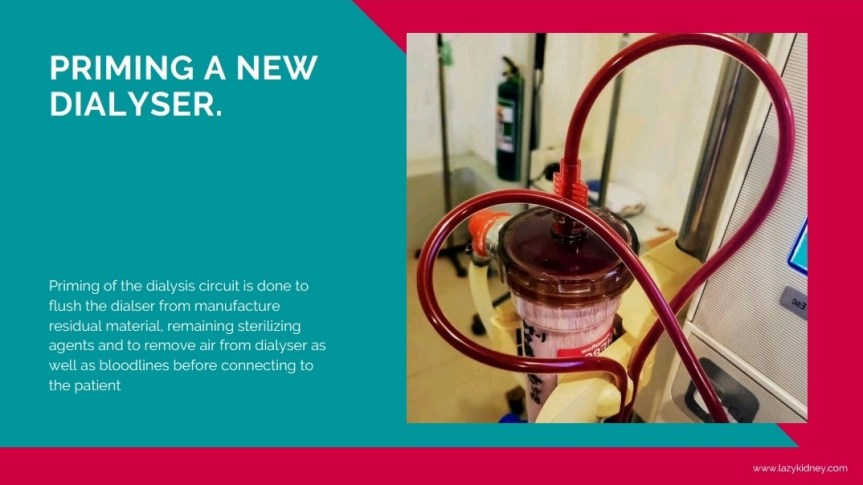
Priming of the dialysis circuit is done to flush the dialser from manufacture residual material, remaining sterilizing agents and to remove air from dialyser as well as bloodlines before connecting to the patient.
Priming Procedure:
Step 1: Proper Personal protective equipment (PPE) such as; face mask, apron & glove, should be worn by dialysis Patient care technician / Dialysis Therapist before beginning the priming procedure.
Step 2: Make sure the machine underwent disinfection at the starting of the shift and water rinse is completed. If not make sure disinfection and water rinse are completed before taking a patient for dialysis in that machine. Make sure machine has passed all the safety and pressure tests. If not put the machine for safety and pressure test and continue priming.
Step 3: Check the patient file for Nephrologists order and verify the dialysis prescription that you are using the same dialyser which is prescribed to the patient by a nephrologist.
Step 4: Check the dialyser and blood tubing packing for any damage, manufacture defect and expiry date before tearing it off the packet.
Step 5: Place the dialyser in the dialyser holder.
Step 6: Take the arterial blood tubing and place the smooth semi-rigid area of the tubing into the blood pump section. Place the arterial drip chamber in the hanger, provided in the machine. (Red color is the universal color coding for the arterial side of dialysis circuit)
Step 7: Take venous blood tubing and connect the venous line patient end to the Priming container. Make sure the tip of the venous line patient end is not in contact with priming container. (Blue color is the universal color coding for venous side of dialysis circuit)
Step 8: Place the venous drip chamber in a hanger provided in the machine or in an air detector if applicable. Clamp all the lines of venous blood tubing.
Step 9: Spike a 1lt 0.9% normal saline with a sterile IV set (Intravenous administration set) and connect it to the saline line at the arterial blood tubing, which lies immediately before blood pump.
Step 10: Open clamp in the IV set and allow normal saline to pass through the arterial patient end of the tubing when all of the air is purged out clamp the arterial patient end of the tubing with the help of big red clamp provided with the tubing.
Step 11: Prime the heparin administration line by loosening the cap and flush the line with normal saline. Tighten the cap and clamp the heparin line when it is done. You can also prime the heparin administration line with heparin if your unit allows doing so. If the patient is not receiving any heparin, clamp the heparin line and tie a knot. Clamped and knotted line clearly indicates the patient is not receiving any heparin during treatment.
Step 12: Take the dialyser end of the arterial line and place it over priming container and press PRIME button in the machine and turn on the blood pump. Fill the arterial drip chamber by loosening the cap; fill the chamber till the 3/4th of it or till manufacture recommended line. Prime the arterial blood tubing till all the air purged out and turn off the blood pump.
Step 13: Connect the Dialyser end arterial blood tubing to the arterial blood port of the dialyser and connect the dialyser end venous blood tubing to the venous blood port of the dialyser. Turn the dialyser, venous end up which allows the blood compartment to flush from bottom to top which helps in removal of air.
Step 14: Reduce the blood pump to 150-180 ml/min so that it facilitates removal of air bubbles from the dialyser. Air bubbles affect the ability to remove toxins and contribute to clotting of the dialyser. Turn on the blood pump. Flush the dialysis circuit until a minimum of 200-300 ml of normal saline is drained from the 1lt normal saline bag and all the air is removed from the dialyser. A gentle tap on the dialyser header aids in the removal of trapped air.
Step 15: Turn off the blood pump and clamp the patient end venous tubing. Connect patient end venous tubing to patient end arterial tubing with the help of connector present at arterial tubing and open both patient end arterial and venous clamps.
Step 16: Fill the venous drip chamber to its 3/4th by loosening the cap of one of the short tube connected to the venous chamber. Tighten the cap and clamp the line when 3/4th if the chamber is filled. Connect the transducer protector to the machine and open the clamp, make sure no saline enters the transducer protector. If transducer protector is loosely connected or contaminated with saline it might result in false pressure reading, air entering the circuit or blood leak from the circuit.
Step 17: Make sure Venous chamber is placed in an air detector monitor and venous tubing is placed between air detector clamp.
Step 18: Check the Dialysate conductivity, make sure it meets the specification of the patient’s prescription. Connect the dialysate lines to the dialysate ports of the dialyser. Connect red Hansen connector to the arterial side dialyser port and blue Hansen connector to the venous side dialyser port. Do not connect dialysate lines to the dialyser if blood side compartment of the dialyser is not filled with normal saline properly, this might result in trapping of air inside the dialyser fibers that lead to clotting of the dialyser.
Step 19: Rotate the dialyser such a way that arterial side is up and venous side is down. Check the dialysate side of the dialyser is free from air and filled with dialysate. Make sure the machine is not placed in bypass mode.
Step 20: Increase the blood pump speed to 200 ml/min. When in recirculation keep the saline line open. Recirculate for 5-10 min with UF goal of 200-300 ml. Recirculation should not exceed 2hours, bacterial proliferation in the dialysis circuit occurs if recirculation is continued for more than 2 hours. If recirculation exceeds 2 hours use fresh supplies.
Discard the saline used for priming before connecting the circuit to the patient. Place a new 500ml or 1lt normal saline for treatment use.
 LazyKidney